
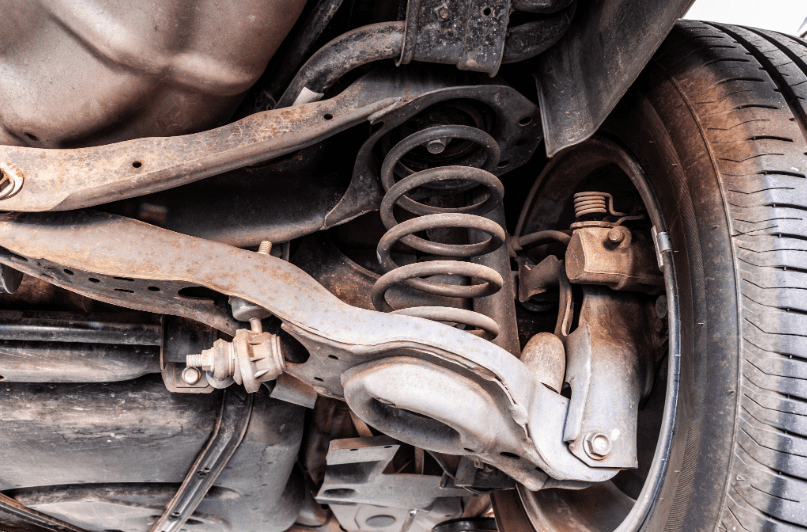
Most people think of suspension as the parts that make the ride smoother. That’s true, but it’s also much more than comfort. Your suspension keeps the wheels pointed the right way, the tires gripping the pavement, and your steering predictable. When parts wear out, they don’t just make things bumpy — they can throw off alignment, chew through tires, and even make the vehicle unsafe.
Suspension really has three jobs: keeping tires on the road, cushioning bumps, and supporting steering and braking. It does all of that with a lot of moving pieces, some familiar and some not-so-familiar.
The parts most people know are:
-
Shocks & Struts – control bounce and keep tires from hopping down the road. Worn shocks cause nose-diving, body roll in corners, and uneven tire wear.
-
Springs – carry the weight of the vehicle and maintain ride height. A sagging spring will change your alignment and wear out tires.
-
Control Arms & Bushings – connect the wheels to the frame, letting them move while cutting down on vibration. Bad bushings cause clunks and looseness in steering.
-
Ball Joints – like the suspension’s shoulder joints, allowing wheels to move up and down while turning. Worn ones mean sloppy steering or even a collapsed wheel.
-
Tie Rods – link the steering rack to the wheels. If worn, steering feels loose and alignment won’t stay in spec.
-
Sway Bar & Links – keep the vehicle flat in corners. Bad ones cause extra sway and instability.
Those are the big names, but they’re far from the only players. Many suspension issues come from the smaller, often overlooked parts:
-
Trailing Arms – control forward-and-backward wheel movement.
-
Lateral Arms – keep the rear wheels centered side-to-side.
-
Panhard/Track Bar – holds the rear axle in place on many trucks and SUVs.
-
Idler & Pitman Arms – part of older truck steering systems; worn ones cause wandering.
-
Center/Drag Link – ties steering components together and can mimic suspension looseness when worn.
-
Bushings Everywhere – sway bars, arms, and mounts all use rubber cushions. When they dry out or crack, you’ll get squeaks, rattles, and vibration.
-
Wheel Bearings & Hubs – not always thought of as suspension, but when they wear, they hum, growl, and make steering feel loose. They can even mimic alignment problems.
-
Subframe/Cradle Mounts – hold the suspension cradle to the body. If they fail, the whole suspension can shift under load.
Not every vehicle has all of these parts. A compact sedan may have MacPherson struts in the front and a simple torsion beam in the rear. A pickup truck might use leaf springs and a solid rear axle. A luxury SUV could have an independent multi-link design with air ride or adaptive struts. “Suspension” isn’t one single setup that looks the same across every vehicle — it’s a collection of parts working together, and the exact design depends on the size, weight, and purpose of the vehicle. That’s why when someone says “I need suspension work,” it could mean anything from replacing a pair of worn struts to rebuilding a system full of arms, bearings, and bushings.
Not every vehicle uses the same type of shocks and struts, either. Standard hydraulic or gas-charged versions are the most common and keep things simple and reliable. Some vehicles, though, are built with more advanced systems designed to fine-tune ride and handling.
-
Air ride uses rubber air bags and a compressor to adjust ride height and comfort.
-
Magnetic ride (MagnaRide) relies on a special fluid that responds instantly to magnetic fields, giving a balance of comfort and performance.
-
Adaptive electronic struts use sensors and computer controls to adjust firmness as you drive.
Each of these systems is designed with a different goal in mind — from smoothing out heavy loads to giving sports-car handling — and because they work in different ways, the cost and type of repairs can vary as well. Sometimes it’s as simple as replacing a strut, other times the system may need attention as a whole.
The takeaway? Suspension isn’t just about ride comfort. It’s the system that connects everything — steering, braking, alignment, and safety. The well-known pieces like shocks and struts matter, but so do the hidden ones like bushings, trailing arms, and wheel bearings. And while different suspension systems don’t all work the same way, understanding what your vehicle has helps explain why maintenance needs — and repair costs — can look so different from one car or truck to another.
Signs Your Suspension Needs Attention
If you notice any of these, it may be time for a closer look:
-
Uneven or rapid tire wear
-
Vehicle pulling to one side
-
Clunks, rattles, or squeaks over bumps
-
Excessive bounce or sway when turning
-
Nose-diving when braking
-
Steering that feels loose or wanders
-
Humming or growling noises from the wheels
If you’re seeing (or hearing) these symptoms, it doesn’t always mean a single part is failing — it could be several components working together. That’s why suspension is best checked as a system, not just one piece at a time.
At S.P.O.T.S. in Aledo, IL, we inspect suspension and alignment together, so we can tell you exactly what’s worn, what’s still in good shape, and what it will take to keep your vehicle safe and comfortable. Whether it’s a simple strut replacement or diagnosing a more complex system, we’ll walk you through it step by step.